
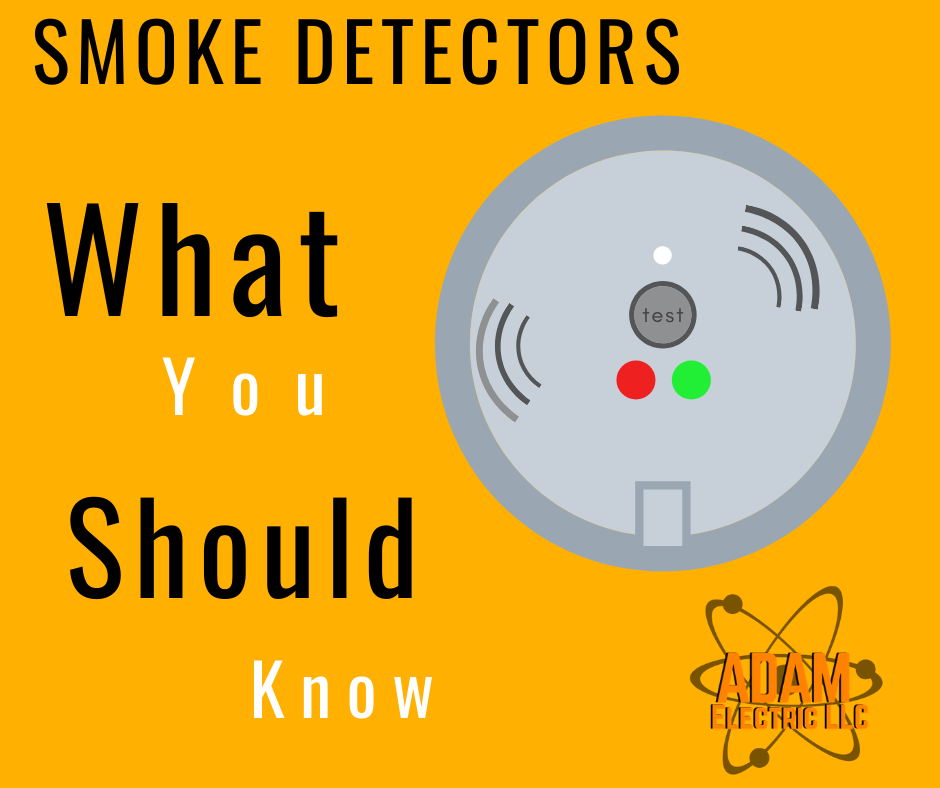
Unless you live under a rock, there is a good chance you know what a smoke detector is; today we will be going into a little more detail to make sure yours are up to code.

Smoke detector history…
A smoke detector is a device that can alert you to smoke and fire dangers. A hundred years ago, people had about a 1 in 10 chance of surviving a fire in their home. Today rate of survival is over 10 times that, and early detection of smoke is a huge factor. The first automatic electric fire alarm was patented in 1890 by Francis Robin Upton, who was an associate of Thomas Edison. These devices were expensive and only used commercially at the time. It wasn’t until the 1960s that affordable smoke detectors were available.
How do they work?
There are many different types of smoke detectors. The two most common types are photoelectric and ionization. They are similar in their basic function but are actually quite different. Ionization detectors contain a small amount of americium-241, which ionizes the air particles and allows a small amount of current to flow between the contacts. When smoke is present, the flow of ions slows and triggers the alarm. A photoelectric detector uses a beam of light and a photosensor. The sensor is located so that in normal conditions, it cannot see the beam of light. When smoke is present, it will scatter the light beam which illuminates the chamber and activates the sensor.
Why/ When should you check your Smoke detectors?
Smoke detectors are critical for early detection of potential fire dangers.
We recommend doing a monthly test and changing them at least every 10 years, but you should always refer to the manufacturer’s instructions. You usually test the detector by holding down on the “test” button for 3-5 seconds, or until you hear the alarm sound.
Most smoke detectors are rated for 10 years, meaning the entire unit should be changed every 10 years, not just a battery replacement.

Smoke detectors are required in all sleeping areas and hallways directly out side of sleeping areas.
Where are Smoke detectors required?
In a residential setting, smoke detectors are required in all sleeping areas and directly outside the sleeping areas, such as a hallway. You are also required to have at least 1 CO detector on each level of your home. Code also now requires your smoke detectors to be interconnected, meaning when one goes off, all of them go off. New wireless interconnected models are available and tend to be more economical than hardwired interconnecting.
Wired Vs Battery operated.
Both types contain a battery, one is battery only, the other is 120 volts with a battery back-up, in case of power outages. In Anchorage, it is required that you reinstall a hardwired device if your home has the wiring available. In other words, you cannot install a battery-operated device if your home is wired for hardwired devices.
Look at your ceiling, are your smoke detectors discolored? Chances are it is time to replace! Contact us today for a free smoke detector assessment in your home.
Here is a great wireless interconnect option: click here